Smart AI, Dumb Email: Why Corporate Comms Fail to Connect with Humans

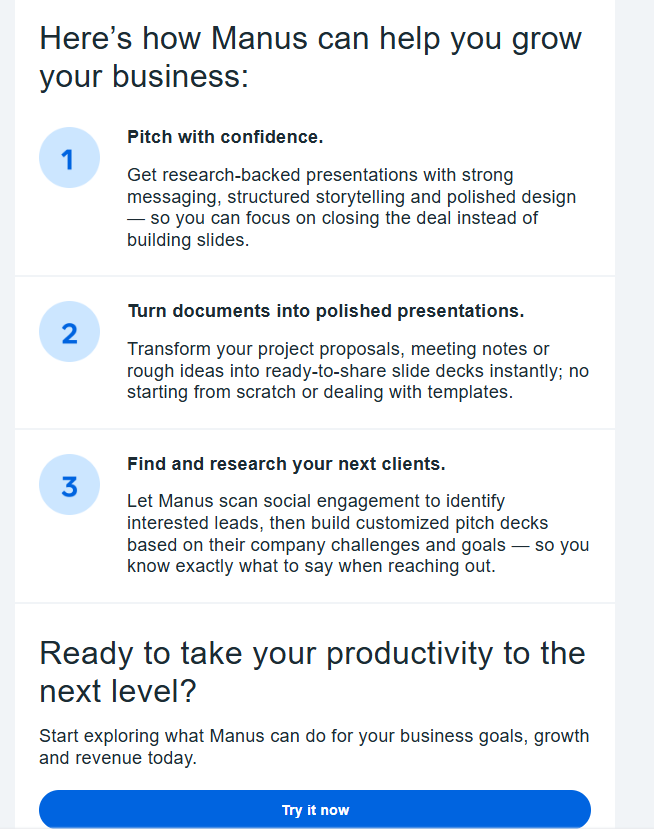
I opened my inbox and found an unsolicited pitch from a tech giant. Meta wants me to try out Manus, their latest AI tool. Because the email landed in my personal inbox, I assumed it contained a personal utility.
I read the copy to figure out how it fits into my workday. The email promises to help me "pitch with confidence" and "take your productivity to the next level." It highlights features like "structured storytelling and polished design."
It reads very professional, but is also completely useless.
I had actually downloaded Manus some time ago when Chinese AI tools first exploded onto the scene. I ended up deleting the app because I failed to find a use case for it. So the email from Meta was not entirely random. They obviously pulled my contact info from the acquisition.
But Meta knows much more about me than just my email address. They know my Facebook and Instagram accounts are virtually dormant. They know exactly when I downloaded Manus and exactly when I abandoned it.
With all that behavioral data at their disposal, you would think they could craft a targeted pitch designed to win back a churned user. Instead, they blasted out a generic feature list.
After reading the entire email, I was left with the exact same problem I had when I deleted the app in the first place. What does this tool actually do for me? The email fails to provide a single, relatable human scenario. It treats a direct, highly targetable communication channel like a broad corporate press release.
The Delusion of Institutional Authority
This Manus email is just a symptom of a systemic disease: the corporate world’s obsession with meaningless copy.
Just read through any corporate homepage. You will see headlines promising to "empower the future of work." You have to scroll through three pages of "scalable solutions" just to figure out if the company sells project management software or ergonomic chairs.
This happens because corporate communications teams operate under a false premise. They believe that sanitized, buzzword heavy language projects authority. They think sounding "institutional" makes the product seem powerful. In reality, when an end user, like myself, receives an email devoid of a clear use case, they do not see authority. We see spam. You cannot build trust with a user if you refuse to speak their language.
The Echo Chamber Contagion
This institutional voice is bred and perfected on platforms like LinkedIn. It is the ultimate echo chamber for corporate word salad.
LinkedIn is a performative space where companies write for other companies. Marketers spend all day churning out phrases like "AI-driven scalable solutions" and "synergistic workflows." They become so fluent in the language of their competitors that they lose all perspective and when it is finally time to talk to an actual customer, they forget to turn off the corporate jargon.
That is exactly what happened here. I believe someone at Meta knows there is a real Manus use case for an individual like me, which is why the algorithm targeted my inbox. But their comms team completely failed to reveal it.
The Economics of Vague Copy
If we analyze why this copy is always so vague, it comes down to a structural fear of shrinking the Total Addressable Market.
Companies are terrified of excluding a single theoretical dollar. They worry that if they name a specific use case, like "perfect for freelance graphic designers pitching new clients," a corporate sales manager will scroll past. To avoid alienating anyone, marketers strip away all specific details, industries, and job titles. They retreat to universal, meaningless phrases like "grow your business." But when you try to write for everyone, you end up writing for no one. The copy becomes a blunt instrument. It is so broad that the user cannot visualize themselves actually using the product.
Slow Death by Consensus
Even when a copywriter drafts a sharp, specific scenario, it rarely survives the corporate approval process. Good writing requires a distinct point of view. Corporate copy is designed to survive committees.
The Draft: A writer starts with a clear, relatable hook.
The Product Manager: Injects technical jargon to ensure their favorite backend feature gets mentioned.
The Legal Team: Strips out any definitive claims to avoid liability.
The Brand Team: Sands down whatever personality is left to ensure it sounds "professional."
The final output is the exact boilerplate ambiguity you see in the Manus email. It reads very professional, but also completely useless.
The Antidote: Scenarios over Features
Good product marketing requires setting a scene, a protagonist, a recognizable problem, and a solution. Let’s look at the second point in the Manus email to see exactly how we can fix this.
The Corporate Word Salad: "Transform your project proposals, meeting notes or rough ideas into ready-to-share slide decks instantly; no starting from scratch or dealing with templates."
The Human Translation: "You just finished a one-hour discovery call. Drop your raw meeting notes into Manus, and it will instantly generate a 10-slide deck that you can tweak to be exactly what your client asked for."
This version puts the reader in a specific, highly relatable situation. It eliminates the cognitive load. The user does not have to invent a reason to use the tool because you just handed them one.
The Bottom Line
Targeted emails should not read like highway billboards. If there is a legitimate Manus use case for an individual user, good copy needs to spell it out. If the tool is actually meant to solve an enterprise problem, then the email never should have landed in my personal inbox to begin with.
The ultimate irony here is that tech giants sell us on the promise of super intelligent AI that can perfectly classify data and target users. Yet, when it comes to selling those exact AI tools, they abandon their own technology and blast out untargeted word salad.
If a company cannot clearly articulate how a product fits into my actual workday, then such emails are good old spam.


Dumb email because AI is not that smart when talking to humans. Haha